|
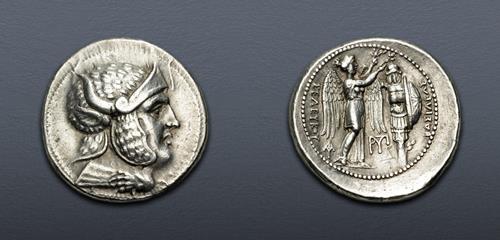
SELEUKID EMPIRE. Seleukos I Nikator. Second satrapy and kingship, 312-281 BC. AR Tetradrachm (27.5mm, 17.03 g, 3h). Susa mint. Struck circa 300-295 BC. Good VF.
CNG Feature Auction 133
Lot: 370. Estimated: $ 1 000
Greek, Coin-in-Hand Video, Silver
Sold For $ 4 000. This amount does not include the buyer’s fee.
Go to Live
|
|
SELEUKID EMPIRE. Seleukos I Nikator. Second satrapy and kingship, 312-281 BC. AR Tetradrachm (27.5mm, 17.03 g, 3h). Susa mint. Struck circa 300-295 BC. Head of hero (Alexander or Seleukos?) right, wearing helmet covered with panther skin and adorned with the ear and horns of a bull / Nike standing right, holding wreath she places on trophy to right; monogram to lower left, monogram in lower middle field. SC 173.5b; ESMS Tr.37 (A29/P4); HGC 9, 20. Lightly toned, graffito in field on reverse. Good VF.
The Trophy coinage of Susa began circa 300 BC, in the aftermath of the pivotal Battle of Ipsos, ending the Fourth Diadoch War, which saw the final defeat of Seleukos' most formidable enemy, Antigonos I Monophthalmos, whose power in Asia Minor posed the greatest threat to the nascent Seleukid empire. Traditionally, this coinage was thought to have begun slightly earlier, marking the successful end of Seleukos' Indian campaign in 305 BC, but a recent analysis of the iconography recognized that the details of the trophy indicated that a Macedonian enemy was defeated; the star on the shield was an Argead device, which clearly identifies the vanquished opponent as the Antigonid enemy that fell at Ipsos (see P. Iossif, "Les monnaies de Suse frappées par Séleucos Ier: Une nouvelle approche" in QT XXXIII [2004], pp. 249–71). The portrait on the obverse has long been the subject of debate, with numismatists identifying him as Dionysos, Alexander, or Seleukos. The arguments for each identification have merit, and indeed they are probably all correct; the image is an assimilation of all three into a singular portrait, as Iossif argues. In contrast to the reverse, which relates to the western victory of Seleukos, the obverse portrait relates to Seleukos' eastern victory and ties his mythology to that of both Dionysos, the first conqueror of India, and Alexander, the second conqueror of India. Thus, this issue celebrates the totality of Seleukos' victories in the east and west, solidifying his new empire, and also further establishes his dynastic heritage by tying his exploits to that of the great conqueror, Alexander, in an effort to legitimize Seleukos' right to rule over these vast lands.
The final winners of all CNG Feature Auction 133 lots will be determined at the live online sale that will be held on 15-16 September 2026.
CNG Feature Auction 133 – Session Two – Lot 309-594 will be held Tuesday morning, 15 September 2026 beginning at 2:00 PM ET.
Winning bids are subject to a 22.5% buyer's fee for bids placed on this website and 25% for all others.
We recognize that our users may have various Internet Browsers and Operating Systems. We like our visitors to have the best possible experience when using our bidding platform. However, we do recognize that it is impossible to develop applications that work identically, efficiently and effectively on all web browsers. The CNG bidding platform supports the latest stable major version and stable previous version of Chrome and Firefox.
|
