|
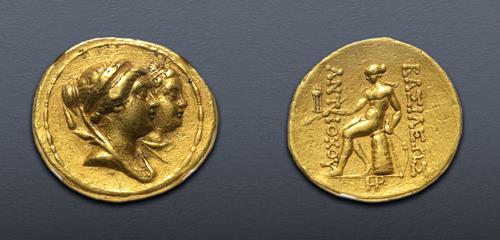
SELEUKID EMPIRE. Antiochos, son of Seleukos IV. 175 BC. AV Oktadrachm (31mm, 34.25 g, 1h). Antioch on the Orontes mint. Jugate busts right of Laodike, veiled and wearing diademed stephane, and Antiochos, diademed and draped, in fillet border / BAΣIΛEΩΣ ANTIOXOY, Apollo, nude, testing arrow in extended right hand and placing left hand on grounded bow to right, seated left on omphalos; tripod to outer left, monogram in exergue. SC 1368a; Le Rider, Antioche 1 (A1/P1); HGC 9, 608; G. Le Rider, “L’enfant-roi Antiochos et la reine Laodice” in BCH CX (1986), fig. 1 (same dies). In NGC encapsulation 3762713-001, graded Ch VF, Strike: 5/5, Surface: 3/5, scratches. Extremely rare, only two oktadrachms of this issue previously known (the Le Rider specimen above, and CSE 91 [the latter with a different monogram]).
This remarkable and exceptionally rare gold oktadrachm, one of three known examples, bears testament to the complex dynastic politics and marital practices of the Seleukid ruling family. Portrayed on the obverse are Laodike IV, daughter of one Seleukid king and wife to two others, along with her son, a child of between three and five years of age, whose ephemeral reign did not merit a regnal number, leaving him known to history only as “Antiochos, son of Seleukos IV” or “Antiochos the Child.”
By the early second century BC, the Seleukid Empire had begun to adopt the practices of the rival Ptolemaic Kingdom of Egypt, including the striking of huge gold coins, such as this example, and the custom of brother-sister marriage. The latter was initiated by Antiochos III “the Great” (225-187 BC), who, in 196 BC, wed his eldest son, also named Antiochos, to his daughter Laodike IV. When the younger Antiochos died only three years later, Laodike was married to the next brother in line, Seleukos, who went on to inherit the throne in 187 BC as Seleukos IV Philopator (187-175 BC). The sibling union produced at least three children: a daughter, Laodike V, likely born circa 190 BC; a son, Demetrios, born about 185 BC and soon sent to Rome as a royal hostage; and another son, Antiochos, likely born between 181 and 176 BC. Seleukos IV’s reign was largely spent trying to repair the damage caused by his father’s disastrous defeat by the Romans, who had imposed a substantial indemnity of 12,000 talents. To help repay this, Seleukos sent his chief minister, Heliodoros, to secure funds from religious sanctuaries throughout the kingdom, including the Second Temple in Jerusalem. The episode is recounted in the Biblical book of 2 Maccabees, chapter 3, which claims Heliodoros and his entourage were driven from the temple by a divine apparition. This account was lent credence in recent years by the discovery of the Heliodoros Stele, a long stone inscription relating correspondence between Seleukos IV, Heliodoros, and other Seleukid officials in managing financial affairs in Coele Syria and Phoenicia (Israel Museum, 2006-52/1 and 2009-1488/1-3).
In September of 175 BC, Seleukos IV died, possibly assassinated by Heliodoros in the wake of his failed mission to Jerusalem. With the eldest son, Demetrios, far away in Rome, the young Antiochos was elevated to the throne, with his mother, Laodike, as co-ruler; Heliodoros, however, declared himself regent and was surely the real power behind the newly minted regime. Coins, including silver tetradrachms and drachms, were struck at the main mint of Antioch on the Orontes mint bearing the new king’s juvenile portrait to pay the common soldiery, while high-ranking officers and government officials were gifted with gold oktadrachms depicting Laodike with her son. These were the first gold coins of any kind struck by the Seleukids since the reign of Antiochos III; their great rarity today indicates profound difficulties in securing sufficient bullion for the issue. The type employs the standard Seleukid reverse design of Apollo seated on the omphalos and is struck in the name of “King Antiochos” (BΑΣΙΛΕΩΣ ΑΝΤΙΟΧΟΥ), with no mention of the queen; however, her diademed portrait is clearly placed in the foreground, protectively looming over her son. Like Ptolemaic queens, she is shown wearing a veil; however, it is pulled far back on her head “in the north Syrian manner” (Seleucid Coins II, p. 35).
However, the new regime was immediately challenged by Seleukos IV’s adult surviving brother, yet another Antiochos, who had been living in exile in Athens. He quickly gathered enough support to have himself enthroned as Antiochos IV Epiphanes. By the late fall of 175 BC, he had married his brother’s widow and adopted the infant Antiochos to secure himself in power; the fate of Heliodoros is unknown but unlikely to have been benign. Thus the joint reign of the young Antiochos and his mother can have only lasted, at most, a few weeks. By July of 170 BC, the young Antiochos had been assassinated by his uncle; Laodike’s reaction to her son’s murder is unrecorded, but she remained married to Epiphanes for the rest of his erratic reign.
Seleukid gold oktadrachms weigh about seven grams more than their Ptolemaic counterparts, being minted on the heavier Attic weight standard. In Egypt, these immense gold pieces were tariffed at 100 silver drachms, or a mina, and were thus termed “mnaieions,” but it is not known what they were called in the Seleukid realm. The modern term “oktadrachm” refers to their theoretical weight of eight Attic drachms, or 34 grams. Each coin represented about 100 days’ pay for an average soldier or skilled craftsman. Although the Seleukid Empire, at its peak, was vast and wealthy, it had fewer sources of gold bullion than did the Ptolemies, and oktadrachms struck under the Seleukids are seldom encountered, with this type ranking among the rarest and most historically important.
The final winners of all CNG Feature Auction 133 lots will be determined at the live online sale that will be held on 15-16 September 2026.
CNG Feature Auction 133 – Session Two – Lot 309-594 will be held Tuesday morning, 15 September 2026 beginning at 2:00 PM ET.
Winning bids are subject to a 22.5% buyer's fee for bids placed on this website and 25% for all others.
We recognize that our users may have various Internet Browsers and Operating Systems. We like our visitors to have the best possible experience when using our bidding platform. However, we do recognize that it is impossible to develop applications that work identically, efficiently and effectively on all web browsers. The CNG bidding platform supports the latest stable major version and stable previous version of Chrome and Firefox.
|