|
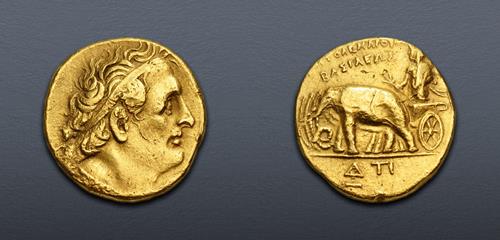
PTOLEMAIC KINGS of EGYPT. Ptolemy I Soter. 305/4-282 BC. AV Stater (16.5mm, 7.09 g, 1h). Alexandreia mint. Struck early 290s BC. VF.
CNG Feature Auction 133
Lot: 401. Estimated: $ 10 000
Greek, Coin-in-Hand Video, Gold
Sold For $ 18 000. This amount does not include the buyer’s fee.
Go to Live
|
|
PTOLEMAIC KINGS of EGYPT. Ptolemy I Soter. 305/4-282 BC. AV Stater (16.5mm, 7.09 g, 1h). Alexandreia mint. Struck early 290s BC. Diademed head right, wearing aegis around neck / ΠTOΛEMAIOY BAΣIΛEΩΣ, Alexander, holding thunderbolt in right hand, standing left in chariot drawn by four elephants left; monogram and TI in exergue. CPE 99; Svoronos 133; Zervos Type VI, Issue 97, dies 763/a; SNG Copenhagen –; Boston MFA 2259 (same dies). Light roughness, a few scrapes and scratches, edge marks, slight bend and minor repair. VF. Extremely rare.
Ex Cleopatra Numismatics inventory M9455 (2024).
Traditionally, this gold coinage was thought to have been a special issue that Ptolemy struck in 305/4 BC to commemorate his assumption of the royal title. Lorber's analysis of the early Ptolemaic coinage, however, has clearly shown that this series was begun in the early 290s BC. In any event, the coinage is remarkable for several reasons. First, the new gold staters were struck at a reduced weight (7.12 grams), an initial step toward the new standard introduced circa 294 BC which would become known as the Ptolemaic standard. Second, and more importantly, Ptolemy became the first Hellenistic king to place his own portrait on his coinage. Finally, the coins exhibit a typological innovation in the Ptolemaic series. The obverse shows Ptolemy wearing the royal diadem and the aegis, a symbol implying a special relationship with Zeus. This portrayal of Ptolemy was used on his subsequent silver coinage, and a stylized version continued to be the standard obverse type on the silver of all the following Ptolemaic rulers down to Kleopatra VII. The reverse type, king in elephant chariot, was not novel among Greek coinage, and also appears around the same time in the coinage of Seleukos I. However, its appearance as a type in Egypt was new, and was likely used to emphasize a connection between Ptolemy and Alexander the Great (the elephants being a reference to Alexander's eastern anabasis). These staters were simultaneously issued in Alexandreia and Kyrene, and are differentiated only by style and the monograms that appear in the exergue of the reverse. In his study of the Alexander coinage of Egypt, Zervos noted 15 distinct issues at Alexandreia struck from 20 obverse dies. Although there certainly must have been a substantial quantity that was struck, the subsequent reducing of the standard, circa 294 BC, must have resulted in many of these coins being melted down (see Lorber, op cit. p. 60). As such, only a handful of each issue are known today.
The final winners of all CNG Feature Auction 133 lots will be determined at the live online sale that will be held on 15-16 September 2026.
CNG Feature Auction 133 – Session Two – Lot 309-594 will be held Tuesday morning, 15 September 2026 beginning at 2:00 PM ET.
Winning bids are subject to a 22.5% buyer's fee for bids placed on this website and 25% for all others.
We recognize that our users may have various Internet Browsers and Operating Systems. We like our visitors to have the best possible experience when using our bidding platform. However, we do recognize that it is impossible to develop applications that work identically, efficiently and effectively on all web browsers. The CNG bidding platform supports the latest stable major version and stable previous version of Chrome and Firefox.
|
