|
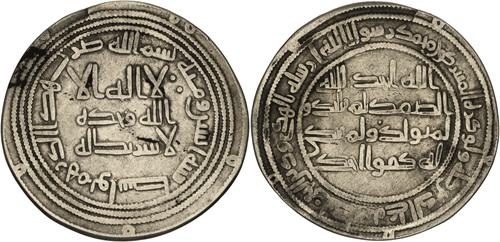
Umayyad Caliphate, Silver coinage. AR Dirham (26.4mm, 2.58 g, 12h). Wasit mint. Dated AH 102 (AD 720/1). Obverse: Annulets o o o o oo, two pellets below mi’a in date / Reverse: Annulets o o o o o. Unpublished. Cleaned. Near VF. Of the highest rarity, apparently unpublished and believed unique.
Dirhams struck by the Umayyad governors in Iraq have been studied in detail by Alan Deshazo and Michael Bates (‘The Umayyad Governors of al-‘Iraq and the Changing Annulet Patterns on their Dirhams’, Numismatic Chronicle, Seventh Series, vol. 14 (1974), pp. 110-118). They noted that the annulet patterns on the obverse of dirhams struck at Wasit, Basra al-Kufa changed when the governor there was changed, and that each governor had his own characteristic annulet pattern.
In AH 99, the new caliph ‘Umar b. ‘Abd al-‘Aziz dismissed and imprisoned his predecessor’s governor in Iraq, Yazid b. al-Muhallab. ‘Umar then divided the administration of Iraq between two governorships, with ‘Adi b. Artah appointed at Basra and ‘Abd al-Hamid b. ‘Abd al-Rahman at Kufa. Following this reorganisation, the production of dirhams was also transferred to Basra and Kufa. In AH 100, dirhams were struck at both of these mints for the first time in nearly two decades, but not at Wasit.
‘Umar b. ‘Abd al-‘Aziz died in AH 101. Taking advantage of the disruption caused by the caliph’s death, Yazid b. al-Muhallab escaped from prison and managed to capture Basra. The new caliph, Yazid b. ‘Abd al-Malik, sent his brother Maslama to suppress this revolt, and Yazid b. al-Muhallab withdrew to Wasit later that year. He was still there in AH 102, when it is recorded that he was finally defeated and killed by Maslama’s troops.
The annulet pattern on this coin was also used at Wasit in AH 99, and at Kufa in AH 100 and 101. Dirhams struck at Wasit in AH 101, however, reverted to the familiar arrangement of five small annulets which had been used at Wasit - and almost all other Umayyad dirham mints - prior to AH 99. While DeShazo and Bates regarded this as ‘inexplicable’, this issue was presumably struck by Yazid b. al-Muhallab during his rebellion and occupation of Wasit. That being so, the annulet pattern on the present piece would then indicate that it was not struck by Yazid b. Muhallab, but by the forces which brought Wasit back under caliphal control.
The final winners of all lots in Session One of CNG Islamic Auction 15 will be determined during the live sale held on 28 October 2026.
Session Two of CNG Islamic Auction 15, a timed online sale, will be held on Thursday, 29 October 2026, beginning at 2:00 PM GMT.
Winning bids are subject to a 22.5% buyer's fee for bids placed on this website and in person at the public auction, 25% for all others.
We recognize that our users may have various Internet Browsers and Operating Systems. We like our visitors to have the best possible experience when using our bidding platform. However, we do recognize that it is impossible to develop applications that work identically, efficiently and effectively on all web browsers. The CNG bidding platform supports the latest stable major version and stable previous version of Chrome and Firefox.
|