|
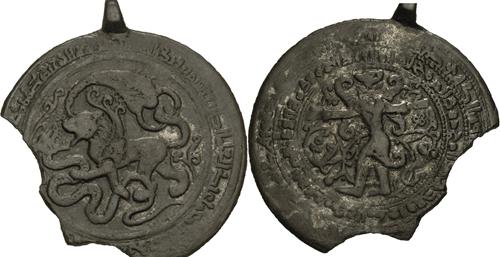
Samanids. temp. Mansur b. Nuh or Nuh II b. Mansur. AH 350-365 / AD 961-976 or AH 365-387 / AD 976-997. Æ Medallion (42mm, 15.55 g, 12h). Samarqand mint. Date off-flan. Bism Allah al-rahman al-rahim duriba… […] …al-Imam ’Abd Allah al-Ta‘i lillah Samarqand, Snake, lion and scorpion (representations of Serpens, Leo and Scorpio) superimposed / Double marginal inscriptions, the outer legend largely unread, the inner apparently comprising repeated benedictions and ‘good luck’ phrases , Lion-headed man, with tail and crescent-shaped wings, standing left with head turned to right. Ilisch 35 = Bivar, M.D.H., ‘Mithraic Symbols on a Medallion of Buyid Iran?’ Journal of Mithraic Studies I (London 1976), pp. 20-25. With loop mount; about 20% broken away and missing. Good VF. Excessively rare .
The example published by Bivar and discussed by Ilisch was intact, but its inscriptions were either unread or unreadable. The legends on the present piece, however, are generally legible, and while the marginal inscriptions on the reverse have not yet been fully read, they clearly include include phrases wishing good luck and blessings on the wearer. Similar ‘good luck’ words are found on a wide range of bronze and ceramic objects from the Islamic east, as well as on coins.
Bivar identified the lion-headed man as the Zoroastrian god Ahriman, and suggested that the astrological symbols shown on the reverse were chosen for their associations with death. Drawing parallels between this piece and two famous Buwayhid gold medallions produced in Baghdad in AH 363, he proposed that all three might have been produced to mark the death of the caliph al-Muti‘. Ilisch argued that the gold medallions could not commemorate the death of al-Muti‘, but he did not dispute Bivar’s interpretation of the Zoroastrian symbolism. Bivar described the imagery on the obverse as a combination of Serpens, Leo and Cancer, although what he apparently interpreted as a crab’s claw looks more like a scorpion on this piece. Whether this is indeed a combination of Mithraic symbols, or perhaps an astrological reference (to a ruler’s horoscope?) is a matter for further research.
The obverse margin is of particular importance, since this preserves both a place-name - Samarqand - and the name of the caliph al-Ta‘i (AH 363-381). This confirms that Bivar was correct to identify the piece as an Islamic medallion, rather than a purely Zoroastrian amulet. Moreover, the mention of Samarqand allows us to attribute it to the Samanids, and the presence of al-Ta’i’s name shows that it must date from the reign of Mansur b. Nuh (died AH 365) or his successor Nuh II b. Mansur (AH 365-387). This shows that Bivar’s suggestion of a date in the 360s, which he made without being able to read this legend, proves to have been remarkably accurate.
The founder of the Samanid dynasty, Saman Khuda, was originally a Zoroastrian, and contemporary writers report that the Samanids showed leniency and tolerance towards the Zoroastrians living under their rule. Samanid rulers fostered a revival of pre-Islamic Persian art and culture, so that modern scholar, Robert Hillenbrand, even described the Samanid mausoleum at Bukhara as ‘a fire temple in Islamic dress.’ It is not surprising, therefore that this Samanid medallion from Samarqand should combine pre-Islamic Zoroastrian symbolism with formal inscriptions in Arabic. including the standard bism Allah duriba… formula used on Islamic donative coins for centuries. Whoever made this remarkable medallion saw no contradiction.
The final winners of all lots in Session One of CNG Islamic Auction 15 will be determined during the live sale held on 28 October 2026.
Session Two of CNG Islamic Auction 15, a timed online sale, will be held on Thursday, 29 October 2026, beginning at 2:00 PM GMT.
Winning bids are subject to a 22.5% buyer's fee for bids placed on this website and in person at the public auction, 25% for all others.
We recognize that our users may have various Internet Browsers and Operating Systems. We like our visitors to have the best possible experience when using our bidding platform. However, we do recognize that it is impossible to develop applications that work identically, efficiently and effectively on all web browsers. The CNG bidding platform supports the latest stable major version and stable previous version of Chrome and Firefox.
|